
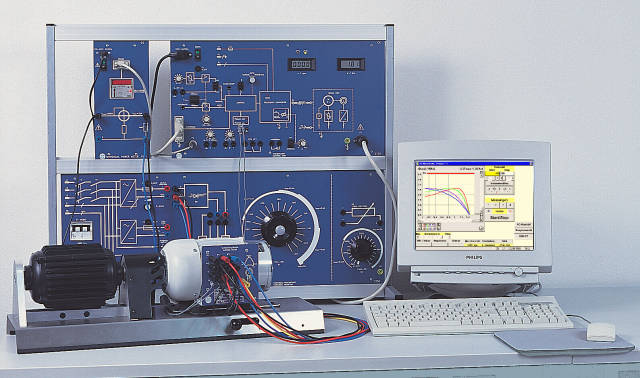
 Family 2700
Type 2740.1
Type 2740.1
Device type · Individual type of the family 2700 Electrical Machines Series 2700
- Assignment
- Type of the series 2700
- Experiments
- 39 in 3 manuals
- As of
- 2026-09-06
Experiments in which type 2740.1 is used according to the component overview or the experiment text (titles, numbers and pages from the tables of contents; German manuals). All manuals and experiments
V 0015 Experiments with the four-quadrant drive Manual · 105 pages 2 experiments
Additional device in this manual View table of contents
- 3.12 Transition from motor to generator operation p. 61
- 3.13 Transition from motor to generator operation with reversal of the direction of rotation p. 64
Other sections mentioning this product (2)
- 2.1.4 Isolation amplifier (Type 8630) p. 17
- 2.3.1 General notes p. 19
No experiment matches the filter.
V 0022 Experiments with the digital frequency inverter Manual · 120 pages 8 experiments
Additional device in this manual View table of contents
- 6.4 Speed and slip with sinusoidal PWM p. 51
- 6.5 Speed and slip with trapezoidal PWM p. 56
- 7.2 Acceleration of a three-phase induction motor under load p. 64
- 8.1 Load-independent speed control p. 70
- 9.2.1 Maximum permissible BOOST of a synchronous machine p. 79
- 9.2.2 Acceleration of a synchronous motor without load p. 80
- 9.2.3 Acceleration under load with sinusoidal PWM p. 83
- 9.2.4 Acceleration under load with trapezoidal PWM p. 86
No experiment matches the filter.
V 0170 Electrical Machines Manual · 206 pages 29 experiments
Additional device in this manual View table of contents
- 2.2 Use of a motor protection switch p. 7
- 3.8.2 Operating a three-phase asynchronous motor in star and delta connection p. 17
- 3.8.3 Efficiency, current and power factor of a three-phase asynchronous motor p. 20
- 4.4.2 Operating the Dahlander motor at low and high speed p. 27
- 4.4.3 Efficiency, current and power factor of the Dahlander motor p. 30
- 5.4.2 Operating the three-phase asynchronous motor (separate windings) at low and high speed p. 36
- 5.4.3 Efficiency, current and power factor of the three-phase asynchronous motor with separate windings p. 39
- 6.4.2 Characteristic curves of the slip-ring motor p. 47
- 7.4.2 Operating the motor with run and starting capacitors p. 56
- 7.4.3 Efficiency, current and power factor of the capacitor motor p. 59
- 8.7.2 Load characteristic of the synchronous generator p. 71
- 8.7.3 Mains synchronisation and regulation characteristic of the synchronous generator p. 74
- 8.8.2 V-curves of the synchronous motor p. 80
- 10.6.2 No-load characteristic of the DC shunt motor p. 95
- 10.6.3 Speed behaviour of the DC shunt motor with field weakening p. 97
- 10.6.4 Load characteristic of the DC shunt motor p. 100
- 10.7.2 Load characteristic of the separately excited DC shunt generator p. 104
- 11.4 Starting the machine p. 107
- 11.6.2 Load characteristics of the DC series motor p. 111
- 12.5 Connecting the machine p. 117
- 12.6.2 Load characteristics of the DC double-wound motor without field weakening p. 120
- 12.6.3 No-load characteristic of the DC double-wound motor with field weakening p. 122
- 12.6.4 Load characteristic of the DC double-wound machine as a shunt motor p. 125
- 13.5 Connecting the machine p. 128
- 13.6.2 Types of compounding of the DC compound motor p. 131
- 13.6.3 Load characteristics of the DC compound machine as a series motor p. 135
- 13.7.1 Types of compounding of the DC compound generator p. 138
- 14.4.2 Load characteristics of the universal motor in DC operation p. 149
- 14.4.3 Load characteristics of the universal motor in AC operation p. 152
Other sections mentioning this product (12)
- 3.8 Experiments on the three-phase asynchronous motor with squirrel-cage rotor p. 15
- 4.4 Experiments on the Dahlander motor p. 25
- 5.4 Experiments on the three-phase asynchronous motor with separate windings p. 34
- 6.4 Experiments on the slip-ring motor p. 44
- 7.4 Experiments on the capacitor motor p. 54
- 8.7 Experiments on the synchronous generator p. 68
- 8.8 Experiments with the synchronous motor p. 77
- 10.6 Experiments on the DC shunt motor p. 93
- 11.6 Experiments on the DC series motor p. 109
- 12.6 Experiments on the DC double-wound motor p. 118
- 13.6 Experiments on the DC compound motor p. 129
- 14.4 Experiments on the universal motor p. 147
No experiment matches the filter.
Type number and description are taken from the component overviews of the hps manuals. Only titles, numbers and pages of the experiments are shown, no manual contents.